
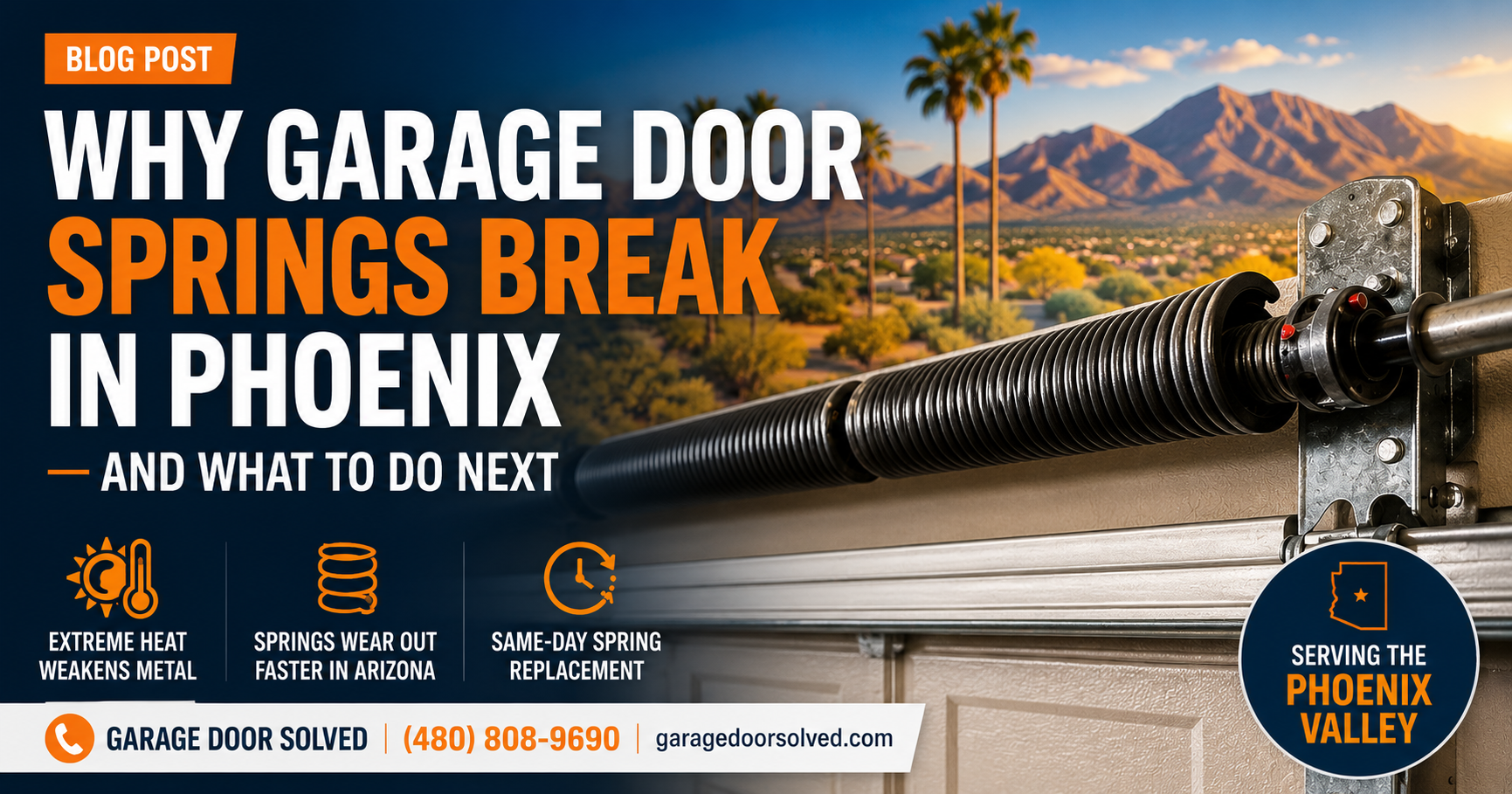

Why Garage Door Springs Break in Phoenix – And What to Do Next
Your garage door worked perfectly last night. This morning — a loud bang, a sagging door, and a car you can’t get out. Sound familiar? In the Phoenix Valley, broken garage door springs are one of the most common service calls we receive, especially during the brutal summer months. Here’s exactly why springs fail in Arizona’s climate, how to recognize the warning signs, and what to do when it happens to you.
Why Phoenix’s Climate Destroys Garage Door Springs Faster
Arizona’s extreme heat cycles create a uniquely hostile environment for metal springs. The Phoenix Valley swings from cool desert nights in the 50s to scorching afternoons that exceed 110°F — sometimes in the same 24-hour period. Steel expands in heat and contracts in cold, and every single temperature cycle puts mechanical stress on the spring coil. Over time, this repeated expansion and contraction causes metal fatigue — tiny cracks forming in the steel that eventually lead to complete failure.
Most garage door springs are rated for 10,000 to 20,000 open/close cycles, but in Phoenix’s climate they routinely fail years ahead of their rated lifespan. UV radiation at Arizona’s latitude compounds the problem — sun exposure degrades the protective coating on spring steel, leaving the metal more vulnerable to oxidation and fatigue cracking.
Two Types of Garage Door Springs
Torsion Springs
Torsion springs run horizontally above the door opening, mounted on a metal shaft. When you close the door, the spring winds up and stores energy; when you open it, that stored energy unwinds to counterbalance the door’s weight — which can be 150 to 500 pounds. Torsion springs are more durable and provide smoother operation, and most Phoenix-area homes built after 2000 use them.
Extension Springs
Extension springs mount along the horizontal tracks on either side of the door. They stretch as the door closes and rebound to lift it when opening. Older homes and some budget installations still use extension springs. They require safety cables running through the center of the spring — without these, a broken spring becomes a dangerous projectile.
Important — safety warning: Both spring types are under enormous tension (hundreds of pounds of stored energy). Never attempt to adjust, wind, or replace garage door springs yourself. This is one of the leading causes of serious home-repair injuries. Always call a professional.
Warning Signs Your Spring Is About to Break
- •The door feels unusually heavy when you try to lift it manually.
- •Squeaking, creaking, or grinding sounds during operation, coming from above the door.
- •Visible gaps in the spring coil — a sure sign of partial failure.
- •The door opens slower than usual, or the opener motor strains noticeably.
- •The door opens unevenly — one side rises faster than the other.
- •You notice rust or visible corrosion on the spring coils.
What Happens When a Garage Door Spring Breaks
When a torsion spring snaps — and you’ll know it happened, because it sounds like a gunshot — the door loses its counterbalance entirely and becomes dead weight. Your opener, designed to work with the spring’s assistance, will either refuse to operate or strain and potentially destroy its motor trying to lift an unassisted door.
With a broken spring, you typically can’t open the door manually either — 200 to 400 pounds is far more than most people can safely lift. Your car may be trapped inside or outside for days if you wait on a slow repair company.
The Garage Door Solved Approach to Spring Replacement
- 1.Our technician arrives — typically same day for emergency calls.
- 2.We inspect both springs, cables, and overall door balance before touching anything.
- 3.We safely release remaining tension from the broken spring using proper winding bars.
- 4.We replace both springs — not just the broken one. If one spring failed, the other is at the same wear point and will fail within weeks.
- 5.We wind the new springs to the correct tension for your door’s specific weight.
- 6.We lubricate all moving parts — springs, rollers, hinges, and opener drive.
- 7.We test door balance, opener operation, and the auto-reverse safety feature.
Most spring replacements are completed in under 90 minutes.
Preventing Future Spring Problems
- •Lubricate your springs twice a year with a garage-door-specific spray lubricant (not WD-40).
- •Schedule annual tune-ups — a technician will catch wear and tension issues early.
- •Keep your garage temperature as moderate as possible; even basic attic insulation helps.
- •Don’t ignore squeaking or grinding sounds — early intervention extends spring life significantly.
Visit Us
6315 N 16th St UNIT 150, Phoenix, AZ 85016
6424 E Greenway Pkwy Suite 100-393, Scottsdale, AZ 85254
Broken spring? We can help today
Call Garage Door Solved
Serving Phoenix, Scottsdale, Mesa, Chandler, Gilbert, Tempe, Glendale & the Valley

